
16 de March de 2026
Dynamic Payment Routing for LATAM Merchants

Dynamic payment routing is transforming how businesses handle payments in Latin America. By selecting the best payment path in real time, it improves transaction success rates, lowers costs, and helps merchants overcome challenges like high decline rates, regulatory complexities, and currency issues. With cross-border e-commerce in LATAM growing by 30% annually, this solution is essential for merchants looking to thrive in the region.
Key Takeaways:
- High Decline Rates: 62% of customers abandon purchases after failed payments, with domestic cards often causing issues.
- Cross-Border Complexity: Local regulations, currency volatility, and fraud risks make payments challenging.
- Dynamic Routing Benefits: Boosts approval rates by 10–15%, reduces costs by up to 18%, and ensures smoother transactions across multiple payment providers.
- Local Payment Methods: Systems like Pix (Brazil), OXXO (Mexico), and PSE (Colombia) are prioritised for better performance.
- Scalability: A single API integration simplifies access to 300+ payment methods across LATAM.
Merchants using dynamic routing report transaction success rates of 85–90% and a 20% increase in global sales. For businesses processing over £400,000 monthly, this technology is a game-changer for navigating LATAM’s fragmented payment landscape.
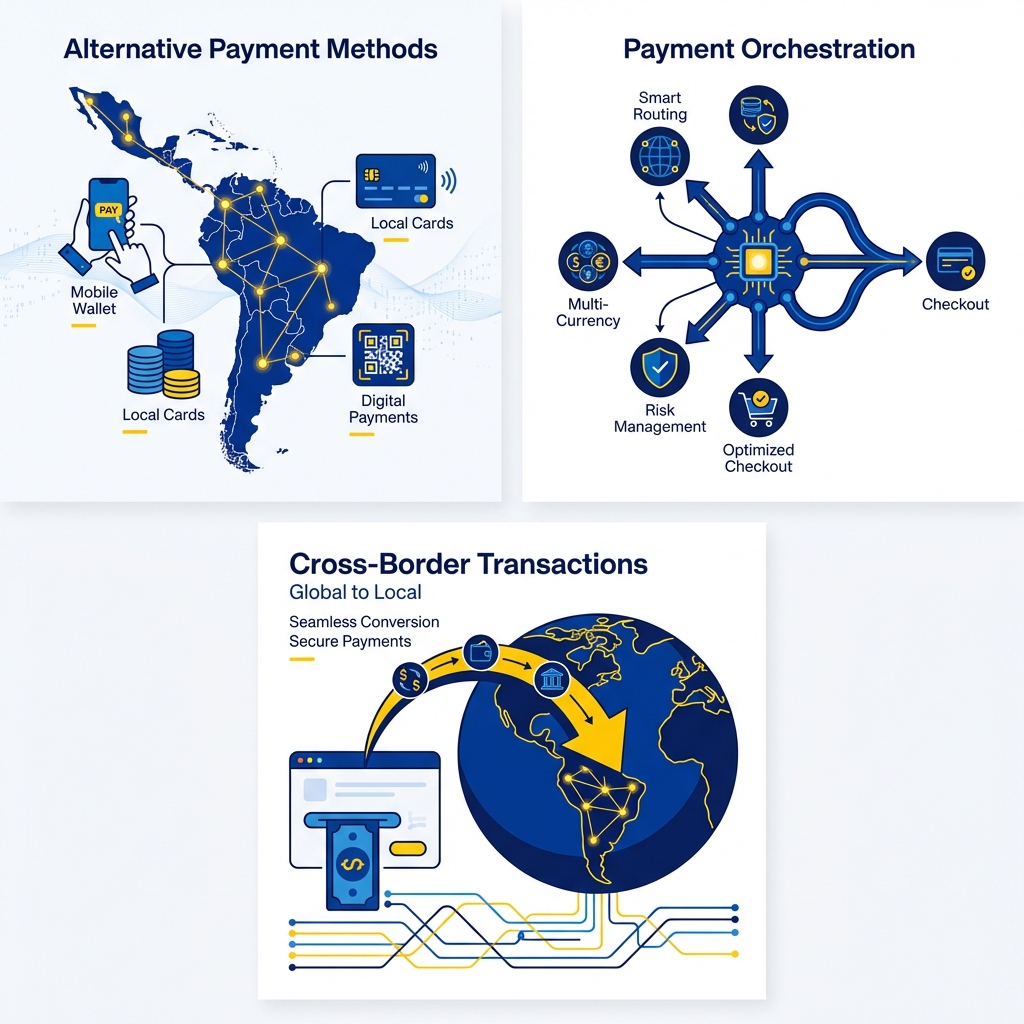
Dynamic Payment Routing Benefits and LATAM Payment Statistics
PPRO Almanac: Corridor Series | US→LATAM – Win with local payments
sbb-itb-adc4ce4
Payment Processing Challenges for LATAM Merchants
Merchants in Latin America face a maze of challenges when it comes to payment processing. From fragmented regulations to economic instability, the hurdles include regulatory complexity, high decline rates for transactions, and the dual threat of currency volatility and fraud.
Regulatory and Compliance Complexity
Unlike Europe, which benefits from more standardised regulations, Latin America operates under a patchwork of country-specific rules. Each nation has its own set of laws governing payments, taxes, and financial institutions. This creates a complicated landscape for compliance, with Anti-Money Laundering (AML) and Know-Your-Customer (KYC) requirements differing significantly from one market to another [12][13].
"Latin America, unlike Europe, has the particularity that, despite being very close, each market is completely different from the other, with its own regulations."
– Jonathan Wilson, Chief Risk Officer, PayRetailers [12]
For instance, Brazil tightened its AML laws in 2012, while Chile requires digital payment providers to adhere to strict KYC protocols [13]. Tax regulations further complicate operations – merchants in Brazil must deal with multiple state-level tax authorities, and Argentina’s strict foreign exchange controls make international settlements a challenge [11][13].
Certain countries also enforce mandatory participation in specific systems. In Brazil, institutions with over 500,000 accounts must integrate with PIX, the instant payment system, while Colombia’s Decree 2242 requires digital invoicing compliance [13]. Additionally, data residency laws in countries like Mexico mandate that financial and customer data be stored locally, with stringent safeguards under laws such as Mexico’s Federal Law on the Protection of Personal Data [13][11].
High Decline Rates for Cross-Border Transactions
Cross-border transactions in Latin America face unusually high decline rates, often due to the widespread use of domestic cards that cannot handle international payments. This results in false declines, where legitimate transactions are mistakenly rejected. Such rejections frustrate customers, leading many to abandon their purchases or turn to competitors with smoother payment processes [14].
This issue is particularly acute for merchants that lack local acquiring capabilities. Without infrastructure to process payments domestically or support for local payment methods like Pix or bank transfers, merchants miss out on a significant portion of potential customers who cannot complete international transactions with their cards [2][4].
Currency Volatility and Fraud Risks
Economic instability in the region adds another layer of difficulty. For example, Argentina has faced inflation rates exceeding 100%, and currencies like the Argentine and Colombian pesos frequently experience devaluations. These fluctuations make revenue forecasting nearly impossible and prompt banks to impose restrictions on international purchases to limit their own risk [9][11].
"The fluctuation will still have effects, but we can reduce them with this kind of solution [local entities and cross-border remittances]."
– Daniel Passarelli, Executive Managing Director for LATAM Digital Commerce, Worldline [9]
Fraud is another persistent issue. Latin America has some of the highest card-not-present (CNP) fraud rates in the world. To combat this, banks often implement strict approval policies, which unfortunately result in the rejection of many legitimate transactions. During peak shopping periods, such as Black Friday, online fraud surges, further complicating the situation [11].
Currency conversion adds yet another challenge. Merchants processing cross-border payments often face technical hurdles and additional costs when converting local currencies into USD or EUR. These complications highlight the importance of using dynamic routing solutions to navigate the region’s complex payment environment effectively [14][8].
How Dynamic Payment Routing Works in LATAM
Dynamic payment routing evaluates each transaction in real time, considering factors like payment method, card issuer, location, and provider performance. This ensures the best pathway is chosen for the transaction. In Latin America, where cross-border transactions make up half of all operations, this approach is essential to minimise declines and avoid unnecessary fees [5].
Real-Time Evaluation and Routing
Dynamic routing tackles the challenges of high decline rates and regulatory hurdles by using real-time assessments. The system follows a logical flow: it first checks if the chosen provider is operational. Then, it ensures geographic compatibility – for example, routing a Brazilian Pix payment locally to avoid cross-border fees and reduce the risk of declines. Lastly, the system picks the route with the highest approval rate history or the lowest processing cost for that specific transaction type [18].
It also uses BIN data to identify the issuing bank, selecting an acquirer with a strong approval rate for that bank. For transactions involving local currencies, the system prioritises providers that can process payments without requiring currency conversion, reducing costs and boosting approval chances. In Peru, where 58% of the population lacks access to traditional banking, the system directs payments to alternatives like digital wallets, such as BCP or BBVA, capturing customers who can’t rely on traditional cards [5].
"Intelligent payment routing is crucial for businesses to optimise transaction success rates and enhance the user experience… By dynamically selecting the best payment path, businesses can reduce payment failures, improve risk management, and increase customer satisfaction."
– Volodymyr Kuiantsev, CEO and Co-Founder, Akurateco [15]
Merchants using smart routing report approval rate improvements of 10% to 15%, particularly for international and multi-currency transactions, while also cutting processing costs by up to 18% [16].
Failover and Cascading Strategies
Failover mechanisms ensure seamless payment processing when the primary provider experiences downtime or a transaction gets a soft decline (like a "Do not honour" response). In such cases, the payment is automatically redirected to a secondary or even tertiary provider [19][20].
Cascading, on the other hand, focuses on soft declines caused by temporary issues, such as processor errors or issuer hesitations. The system retries the payment through an alternative gateway, often recovering transactions that would otherwise fail. Modern cascading systems even carry 3DS authentication data, so customers don’t have to re-authenticate when the transaction is retried [20].
"There are no impacts to the users [of dynamic routing], and the transactions can keep flowing – and it’s a seamless transition."
– Andy McHale, Senior Director of Product and Market Strategy, Spreedly [21]
However, it’s important to avoid excessive retry attempts, as this could trigger fraud alerts and harm a merchant’s reputation [17]. Beyond managing failures, dynamic routing adapts to specific regional behaviours through tailored rules.
Custom Rules for LATAM Markets
Given the limited use of international cards in the region, LATAM-specific rules prioritise domestic payment methods. With only 29% of LATAM consumers having credit cards enabled for international transactions, routing logic directs domestic cards to local acquirers to avoid cross-border declines [2]. For example, it uses BIN data to identify local card schemes like Elo and Hipercard in Brazil or Naranja and Cabal in Argentina, ensuring these payments are processed domestically [2][1].
Routing systems also adapt to instant payment networks. In Brazil, Pix, which handles 33% of total payment volume, is prioritised for its high success rates and lower fees compared to traditional cards [1][4]. In Mexico, SPEI transactions for B2B payments are routed during business hours for optimal results, while in Colombia, credit card transactions follow specific authentication flows to meet local requirements [22].
Time-sensitive routing is another key feature. For instance, during Mexico’s "quincenas" (bi-weekly pay periods) or the "El Buen Fin" shopping event, transaction volumes surge. Routing rules adjust to direct payments to providers that perform better under high traffic [22]. Merchants can also include unique identifiers, like customer loyalty tiers or product types, to optimise provider selection for each transaction [3].
| Country | Key Local Payment Method(s) | Routing Consideration |
|---|---|---|
| Mexico | SPEI, OxxoPay, CoDi | B2B payments perform best via SPEI during business hours [22] |
| Colombia | PSE, Bre-B (upcoming) | Requires specific authentication flows for credit cards [22] |
| Argentina | MODO, Mercado Pago, Naranja | Digital wallets hold a 46% share of e-commerce [4] |
| Chile | Webpay, Mach, Khipu | High credit card dominance (60% of online sales) [4] |
| Peru | Yape, PLIN, PagoEfectivo | A2A payments projected to capture 45% of the market by 2030 [4] |
These tailored rules work seamlessly within broader orchestration strategies, ensuring better performance for cross-border payments across LATAM.
Benefits of Dynamic Payment Routing for LATAM Merchants
Dynamic payment routing offers a practical solution to the payment challenges faced by merchants in Latin America. It directly improves transaction success rates, reduces costs, and ensures operational stability, particularly for cross-border payments.
Higher Approval Rates
One of the standout advantages is the ability to route transactions to local acquirers rather than offshore processors. This approach significantly increases approval rates by avoiding the high-risk flags often triggered by international processors. In Brazil, for instance, international cards account for just 20% of online transactions, making local processing essential [11].
Using historical data, smart routing systems can identify the processor most likely to approve a transaction based on the customer’s issuing bank. These systems also retry soft declines – temporary errors like "Do not honour" – through alternative providers, recovering transactions that might otherwise fail. This process can lead to a 10–15% increase in approval rates for international and multi-currency payments [16].
"By enhancing payment paths and reducing the incidence of unsuccessful transactions, online merchants working with us have experienced significant improvements in their overall transaction success rates, ranging from 85% to 90%." – Philip Plambeck, Managing Director, UK, Computop [6]
This improvement is crucial, considering that 62% of customers abandon their purchase entirely after encountering a failed payment notice [6].
Lower Costs and Fewer Declines
Dynamic routing not only improves approval rates but also reduces processing costs by up to 18% [16]. It evaluates transaction details – such as card type, issuer location, and transaction value – to determine the most cost-effective route while maintaining a high likelihood of approval.
"Dynamic routing can be customised to route transactions to different gateways on parameters such as the lowest cost or the highest authorization rates." – Andy McHale, Senior Director of Product and Market Strategy, Spreedly [21]
Additionally, routing payments to local options like Pix in Brazil or OXXO in Mexico reduces declines caused by customers lacking international credit cards. This flexibility ensures more payments go through, improving the overall customer experience.
Better Resilience and Scalability
Dynamic routing systems also enhance resilience by automatically redirecting transactions during provider outages. If a primary processor goes down, the system shifts traffic to secondary providers seamlessly, preventing disruptions to the customer experience and avoiding lost sales.
Moreover, orchestration layers simplify the addition of new local payment methods or regional PSPs through a single API. This modular approach allows merchants to expand quickly into LATAM markets without overhauling their payment infrastructure [8][11]. With the rise of instant payment systems like Pix and PSE, routing logic can handle real-time bank transfers alongside traditional card payments, eliminating the need for separate integrations.
Merchants using payment orchestration have reported a 20% increase in global sales [6]. For businesses processing over £400,000 monthly, this scalability is critical during peak shopping periods like Mexico’s "El Buen Fin." These features set the stage for effective implementation, which will be explored in the following section.
How to Implement Dynamic Payment Routing
Dynamic payment routing can improve approval rates and reduce costs, but its implementation requires careful planning and a deep understanding of regional nuances. To get started, focus on integrating multiple payment service providers (PSPs), setting up smart routing rules, and tapping into local expertise.
Integrating Multiple PSPs
At the heart of dynamic routing lies a unified API layer. This single integration point connects multiple PSPs, significantly reducing integration time – what once took months can now be done in weeks. Instead of building separate connections for each processor, a payment orchestration platform serves as a central hub, managing transactions between merchants, customers, and providers seamlessly [22][24].
Another crucial component is payment vaulting. By storing customer payment data independently of any one PSP, merchants can avoid being locked into a single provider. This flexibility ensures that transactions can be routed to any provider without losing cardholder data. As Basis Theory highlights:
"In order to have full control of customer payment data, merchants need to ensure it is not held by the PSP, which may subsequently decline to share it for use with other PSPs" [18].
To simplify the process, no-code tools can help merchants set up routing logic based on factors like card type, Bank Identification Number (BIN), or geography. These tools minimise the engineering workload associated with managing multiple PSP connections [25]. Additionally, standardising error codes and reports across providers into one format can cut manual reconciliation efforts by up to 70% [22]. Once the system is integrated, ongoing monitoring is essential to fine-tune performance and respond to regional trends.
Monitoring and Optimisation
Dynamic routing systems thrive on continuous monitoring and adjustment. Real-time tracking of routing signals, combined with machine learning models, can help refine rules to align with regional behaviours. For example, Colombia’s bi-weekly "quincenas" pay cycles or Mexico’s "El Buen Fin" shopping event may require tailored routing strategies [22].
Cascading failover logic is another key feature. It ensures failed transactions are forwarded without excessive retries, which could trigger fraud alerts from card issuers [17][25][26]. Modern orchestration platforms can process 96% of transactions successfully in under six minutes – a stark improvement over the 48–72 hours typical of older methods [22].
Unified reporting also plays a vital role. By consolidating data from all processors into a single record, merchants can easily spot areas for improvement. Andrew Riabchuk, Founder and CTO of Akurateco, points out:
"Even small changes in how you route transactions – like switching providers for a specific BIN or country – can lead to big improvements in approval rates" [26].
Local Acquiring and Regional Expertise
For merchants targeting specific regions, such as Latin America (LATAM), local acquiring is critical. Many cards issued in countries like Brazil and Mexico are not compatible with international transactions, leading to high decline rates when processed offshore [29]. Brazil, for instance, requires foreign merchants to partner with a local acquirer or establish a local legal entity to handle domestic payments [29].
Routing strategies should also account for alternative payment methods like PIX in Brazil, OXXO in Mexico, and PSE in Colombia. These options are essential for reaching the region’s estimated 200 million unbanked individuals [22][27]. PIX alone had over 140 million users by 2023, showcasing its growing influence [29]. Diana Vorniceanu from PayRetailers explains:
"Integrating a quick and easy payment process at checkout can increase conversion rates by up to 20%" [5].
Fraud prevention is another area where regional expertise is indispensable. Fraud attempt rates in LATAM are 97% higher than in other regions, making machine learning models trained on local transaction patterns a necessity [28][29]. Additionally, providing 24/7 customer support in Spanish and Portuguese can foster trust and resolve payment issues more effectively [28][29]. Offering instalment payment options like "parcelado" in Brazil or "meses sin intereses" in Mexico is also vital for high-value ecommerce transactions [29].
PayRetailers: Dynamic Payment Routing for LATAM Merchants
PayRetailers provides a tailored, regulated payment solution designed specifically for merchants operating in the high-volume Latin American (LATAM) market. For businesses processing £500,000 or more monthly, the challenges of handling diverse payment providers, multiple currencies, and complex compliance requirements can be overwhelming. PayRetailers addresses these issues with a robust cross-border payment infrastructure built exclusively for LATAM.
LATAM Payment Infrastructure
PayRetailers simplifies access to over 300 local payment methods through a single API integration, removing the need for separate integrations for each country [23]. This streamlined system enables localised processing and improves transaction approval rates. The platform supports a variety of payment types, including regional cards, bank transfers, mobile money, and cash-based methods like barcode scanning, which are crucial for reaching LATAM’s large unbanked population.
Rodrigo Puig-Mir, Head of Product Development at PayRetailers, highlights this approach:
"Our big advantage is the focus on a single integration approach via one API so that our merchants can easily access the payment jungle in LATAM" [30].
The platform accommodates 24 currencies, allowing transactions in local currencies while settling in major international ones like USD or EUR. This reduces exposure to exchange rate risks and simplifies treasury operations [23]. Additionally, smart routing technology ensures transactions are processed through the most efficient paths, maximising approvals and reducing failures [23].
In-House Compliance and Fraud Prevention
PayRetailers stands out by maintaining physical offices in key markets such as Mexico, Brazil, Argentina, Chile, Colombia, and Peru. These local offices, staffed by country managers, ensure that transactions comply with constantly evolving financial and tax regulations [30]. The platform is licensed under Mexico’s Financial Technology Institutions Law (CNBV) and adheres to European Payment Institution standards.
Fraud prevention is another critical focus. With fraud attempt rates in LATAM being 97% higher than in other regions [28], PayRetailers uses advanced risk scoring models tailored to local payment behaviours. Merchants can customise security settings for individual markets, avoiding a one-size-fits-all approach. Erika Santana, Project Manager at PayRetailers, explains:
"By collaborating with us, the merchant is relieved of the burden of managing local, tax, and financial processes, allowing them to fully focus on their operations and growth strategies" [10].
These compliance and fraud prevention measures enable smoother settlements and scalable solutions for merchants.
Unified Settlements and Scalable Solutions
For high-volume merchants, unified settlements simplify operations by eliminating the need to manage multiple local bank accounts and reconciliation processes. By treating transactions as domestic through local acquiring partnerships, PayRetailers improves approval rates and avoids costly cross-border fees [10].
The platform also supports enterprise-level scalability, offering reporting dashboards that break down transaction volumes by country. This allows businesses to make informed risk management and optimisation decisions [23]. With instant payment systems like PIX – responsible for 29% of Brazil’s eCommerce volume and used by over 500,000 active users – merchants can tap into LATAM’s growing digital payment landscape [10]. The seamless integration of domestic processing further boosts the efficiency of dynamic routing, ensuring transactions are handled locally whenever possible.
Measuring Success and Best Practices
Once dynamic routing is in place, tracking the right metrics is essential to confirm improvements in approval rates, cost efficiency, and customer experience. Start by focusing on authorisation and approval rates – these are critical indicators of success. Keep an eye on the percentage of transactions approved by issuing banks and the share of orders passing fraud and risk checks. For instance, in LATAM, debit card transactions typically have an 18% lower success rate compared to credit cards, making it vital to segment data by payment method to uncover specific issues [17][32]. Merchants who consistently refine their routing rules have reported transaction success rates of 85% to 90% [6].
Another key factor is provider latency and uptime, as these directly influence the checkout process. Monitor response times and the real-time availability of gateways and acquirers. If a provider experiences delays, reroute transactions instantly to avoid disruptions. This proactive approach can maintain smooth checkout flows. Conversion rates also offer valuable insights – businesses using payment orchestration have seen global sales increase by 20% [6].
Key Metrics to Track
To identify inefficiencies and cut costs, track decline reasons and the cost per transaction. Around 10% of all online shopping spend in the UK fails during payment authorisation [6]. Analysing declines by region can reveal patterns; for example, Peru often outperforms Colombia and Mexico in credit card success rates [32]. Smart routing can also reduce processing costs by up to 18% [16]. Using unified reporting tools through an orchestration layer simplifies data consolidation across multiple PSPs, making reconciliation more efficient [31][17]. These insights are invaluable for fine-tuning routing strategies.
Continuous Rule Optimisation
A/B testing is a powerful tool for identifying the best processors for different transaction types [17]. Harris Nghiem from PayCompass highlights the benefits of this approach:
"Smart routing replaces static rules and single points of failure with dynamic routing and data-driven decisions" [17].
Routing rules should adapt to signals like card network, currency, geography, issuer response, and even the time of day [17]. Real-time failover mechanisms are also critical – if a primary gateway encounters issues, traffic should automatically shift to a backup provider [16][33]. However, be cautious with retry attempts; too many retries can trigger fraud alerts from issuers and harm your reputation [17].
Long-Term Strategy
Building a sustainable dynamic routing strategy involves leveraging refined metrics and ongoing optimisations. Success in LATAM markets often requires partnerships with providers who understand local payment preferences and comply with regional regulations. For example, integrating local payment methods like Pix in Brazil, PSE in Colombia, and Webpay in Chile can boost conversion rates by up to 20% – a significant factor given that 50% of e-commerce in LATAM involves cross-border transactions [5]. Using no-code routing engines can empower payment teams to adjust logic and thresholds without heavy reliance on engineering resources [25]. Lastly, keep retry attempts in check to avoid transactions being flagged as fraudulent by issuing banks [17].
Conclusion
In Latin America, where half of all transactions cross borders and payment systems are highly fragmented, dynamic routing has become a necessity. It helps merchants navigate challenges like regulatory hurdles, currency complexities, and high decline rates. The region’s varied payment methods – such as Pix, Boleto, OXXO, and PSE – demand smart routing solutions to ensure smooth transactions. These tools directly address obstacles by improving approval rates, lowering costs, and boosting operational efficiency.
Merchants leveraging dynamic routing and payment orchestration have seen transaction success rates climb to 85%-90%, alongside a 20% increase in global sales [6]. These numbers highlight the importance of working with providers who understand the nuances of LATAM’s payment landscape.
Success in this region depends on partnerships with providers that are well-versed in local challenges. Features like local acquiring, domestic processing, and real-time failover systems are critical for managing the region’s high fraud risks and regulatory complexities. Together, these capabilities make dynamic routing a cornerstone of sustainable growth in LATAM.
For merchants processing over £400,000 monthly, the benefits are even more pronounced. Unified settlement platforms simplify currency reconciliation and streamline operations – an invaluable advantage as LATAM’s cross-border e-commerce volume grows at 30% annually, outpacing overall online sales growth [7].
PayRetailers offers a practical solution through a single API integration, granting access to over 250 local payment methods across 12+ LATAM countries [5]. With in-house compliance teams tracking regulatory changes and smart routing technology optimising transaction paths, merchants can expand across the region without dealing with multiple integrations or complex local tax systems [10].
The rise of instant payment systems like Pix is also transforming LATAM’s e-commerce landscape, raising consumer expectations. Pix alone accounts for 29% of Brazil’s e-commerce volume and 17% across the entire region [7]. Merchants adopting dynamic routing strategies will not only keep pace with these changes but also maintain strong approval rates and cost efficiency – key elements for long-term growth in this rapidly evolving market.
FAQs
What’s the difference between dynamic routing and simple failover?
Dynamic routing leverages real-time data to make smarter decisions about payment paths. It considers factors such as customer location, card issuer, transaction value, and system performance to determine the best route. This method not only boosts approval rates but also helps minimise transaction declines.
In contrast, simple failover sticks to a fixed backup plan. It only shifts to an alternative route when the primary one fails, without adjusting to live conditions or data.
Do I need local acquiring in each LATAM country to reduce declines?
Local acquiring in each LATAM country plays a key role in reducing payment declines. By supporting local payment methods and bypassing banking restrictions, it helps merchants achieve higher authorisation rates. This ensures transactions run more smoothly, making it easier for businesses to operate across the region.
How can I measure if routing is improving approvals and costs?
To truly understand the effectiveness of dynamic routing, focus on analysing critical metrics such as transaction success rates and cost efficiency.
Start by comparing payment approval rates, declines, and failed transactions from before and after implementing dynamic routing. This will provide a clear picture of how well the system is improving payment flows. Additionally, examine transaction processing fees and overall payment costs to uncover potential savings.
Using real-time analytics tools is essential here. These tools allow you to track these metrics continuously, ensuring that the routing remains optimised and performs as expected. By doing so, you can measure the impact of dynamic routing on both approval rates and cost reduction effectively.
Related Blog Posts
Latest news.


